
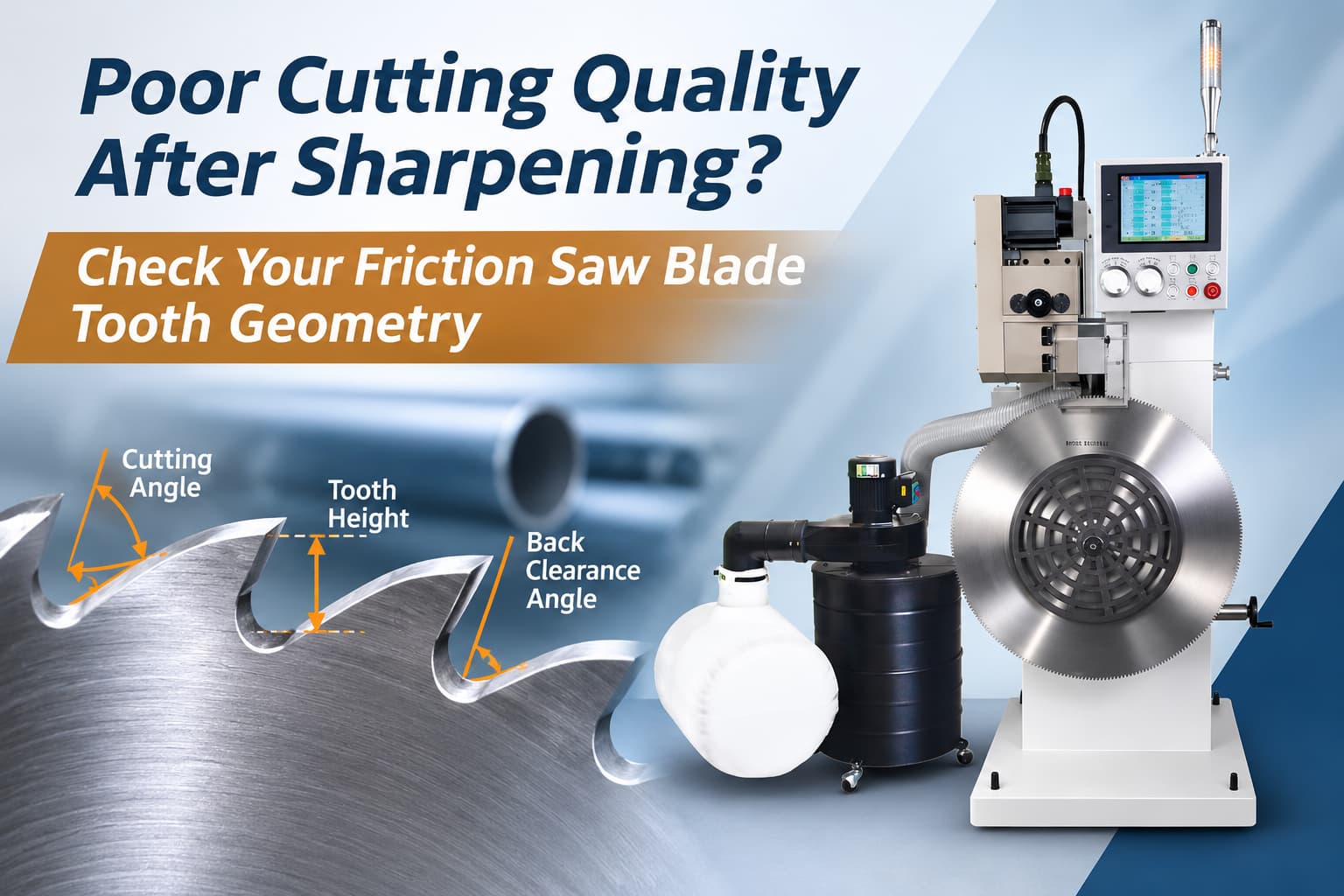
A friction saw blade has just been sharpened, but once it returns to production, the cutting performance still does not feel right. Cutting may become less stable, tooth wear may appear sooner than expected, or the blade may fail to perform as consistently as before.
In this situation, sharpening the blade again may not solve the real problem. The issue could be tooth geometry, particularly the cutting angle, back clearance angle, tooth height, and consistency from tooth to tooth.
For steel mills, tube manufacturers, and sharpening service providers, understanding these factors can help identify why a freshly sharpened friction saw blade is still underperforming.
Quick Check: What Should You Look at First?
When cutting performance remains poor after sharpening, check these areas before assuming the blade simply needs another grinding cycle.
| What to Check | Why It Matters |
|---|---|
| Cutting angle | Influences how the tooth engages with the material. |
| Back clearance angle | Provides clearance behind the cutting edge. |
| Tooth height | Helps maintain consistent tooth engagement. |
| Tooth-to-tooth consistency | Helps prevent individual teeth from carrying uneven loads. |
| Grinding parameters | Affect whether the intended geometry can be reproduced consistently. |
Key Takeaway: A sharpened tooth is not necessarily a correctly ground tooth.
1. Why Can a Sharpened Friction Saw Blade Still Cut Poorly?
Friction saw blades operate under demanding conditions involving high rotational speed, heat, and repeated contact with the workpiece. The geometry of each tooth therefore needs to remain consistent throughout the blade.
A cutting edge may look sharp after grinding, but small differences in tooth geometry can change how individual teeth interact with the material.
For example, if some teeth are higher than others or the grinding angle varies around the blade, the cutting load may not be distributed consistently. Over time, this can contribute to unstable cutting behavior and uneven wear.
This is why friction saw blade sharpening should focus not only on restoring the edge, but also on restoring the intended tooth geometry.
Related Reading: How to Sharpen Friction Saw Blades Efficiently: A CNC Solution for High-Temperature Cutting Applications
2. Is the Cutting Angle Correct?
The cutting angle determines the orientation of the tooth face as it engages the workpiece.
Different blade designs and cutting applications may require different geometry. If the cutting angle produced during sharpening does not match the intended blade specification, simply creating a sharp edge does not guarantee the expected cutting behavior.
When investigating poor performance after sharpening, compare the finished tooth geometry with the blade drawing or original specification rather than judging sharpness visually.
Questions to Check
- Is the cutting angle consistent around the entire blade?
- Does it match the required blade specification?
- Was the correct value entered during the grinding setup?
- Are repeated sharpening cycles gradually changing the original tooth profile?
The goal is not to find one universal "best" cutting angle. The goal is to reproduce the geometry required for that particular friction saw blade.
3. Why Does Back Clearance Angle Matter?
The back clearance angle describes the clearance behind the cutting edge.
If this geometry is incorrect, the relationship between the cutting edge and the material changes. This can affect how the tooth passes through the cutting area and may contribute to unwanted contact or inconsistent performance.
Just like the cutting angle, the correct back clearance depends on the blade specification and application.
This becomes especially important when a blade has been sharpened repeatedly. Small variations from one grinding cycle to another can gradually alter the tooth profile.
Instead of asking only "Is the blade sharp?", a better question is: "Has the correct cutting angle and back clearance geometry been restored consistently across every tooth?"
4. Don't Overlook Tooth Height and Tooth-to-Tooth Consistency
Correct angles alone are not enough.
Imagine a friction saw blade where most teeth have been ground to the intended geometry, but several teeth remain slightly higher or lower. Those differences can affect how the teeth engage with the workpiece.
This is why tooth height and tooth-to-tooth consistency should also be part of the inspection after sharpening.
A useful post-sharpening check should therefore consider:
Together, these factors provide a more complete picture of sharpening quality than edge sharpness alone.
5. Why CNC Control Helps Maintain Tooth Geometry
For large friction saw blades containing many teeth, reproducing the same geometry repeatedly can be difficult when the process depends heavily on manual adjustment.
A CNC-controlled sharpening process allows key grinding parameters to be entered and controlled systematically.
EYAN ASC-1000 CNC Friction Saw Blade Sharpener
EYAN's ASC-1000 CNC Friction Saw Blade Sharpener allows operators to set parameters including:
- Saw blade diameter
- Number of teeth
- Tooth height
- Cutting angle
- Back clearance angle
- Feed speed
- Grinding wheel rotation speed
Once the appropriate parameters have been established for a particular blade, CNC control helps make the grinding process more repeatable from tooth to tooth.
This is particularly useful for manufacturers or sharpening service providers that regularly process friction saw blades and need more consistent results between sharpening cycles.
Explore EYAN's CNC Friction Saw Blade Sharpener ASC-1000 for additional machine information.
From Sharp Teeth to Consistent Tooth Geometry
Good friction saw blade sharpening is not simply about making every tooth sharp again.
For stable cutting performance, the blade needs the correct geometry reproduced consistently across the entire circumference. Cutting angle, back clearance angle, tooth height, and tooth-to-tooth consistency all deserve attention when diagnosing poor cutting quality after sharpening.
For operations handling large friction saw blades, EYAN's ASC-1000 CNC Friction Saw Blade Sharpener provides CNC-controlled adjustment of these key grinding parameters and supports friction saw blades from Ø400 to Ø1000 mm.
Looking for More Consistent Friction Saw Blade Sharpening?
If you are experiencing inconsistent cutting results after sharpening, send EYAN your blade drawing, tooth profile, blade dimensions, and photos of the current tooth condition. Our team can help evaluate your sharpening requirements and determine whether the ASC-1000 is suitable for your application.
Contact EYANFrequently Asked Questions
Why does my friction saw blade still cut poorly after sharpening?
A sharp cutting edge alone does not guarantee correct cutting performance. Cutting angle, back clearance angle, tooth height, and consistency between teeth should also be checked against the blade specification.
What friction saw blade parameters can the ASC-1000 control?
The ASC-1000 allows operators to enter parameters such as blade diameter, tooth count, tooth height, cutting angle, back clearance angle, feed speed, and grinding wheel rotation speed.
What size friction saw blades can the ASC-1000 sharpen?
The ASC-1000 has a published grinding range of Ø400 to Ø1000 mm, making it suitable for large friction saw blade sharpening applications.